The short answer: By their first birthday, or within six months of the first tooth appearing — whichever comes first. That is the recommendation of both the American Academy of Pediatric Dentistry and the American Dental Association, and it surprises most parents, who tend to assume two or three is early enough.
It sounds absurdly early for a child with four teeth. The reason has very little to do with the teeth themselves.
Why the first birthday, and not age three
A one-year-old’s first dental visit is not really a dental examination in the way an adult would understand it. It is a prevention appointment, and it exists for three reasons.
To catch problems before they hurt. Early childhood decay can begin as soon as teeth appear. It is much more common than people expect, and in its early stages it is completely painless and easy to miss — a chalky white line along the gumline is often the first sign, and it does not look alarming. By the time a child complains, the decay is usually well established.
To coach the parent, not the child. Most of the value in that first visit goes to you. How much toothpaste to use at this age. How to brush a toddler who does not want to be brushed. Whether the bottle at bedtime is causing damage. Whether thumb-sucking matters yet. These are the questions that shape the next five years of your child’s dental health, and getting answers early prevents most of the problems we would otherwise be fixing at age four.
To make the dental office boring. This one is underrated. A child who first visits a dentist at age one, and comes back twice a year for nothing more than a look and a polish, learns that this is an unremarkable place where nothing bad happens. A child whose first visit is at age five because a tooth hurts learns something entirely different — and that association can last decades. A substantial share of the adults we treat with dental anxiety trace it to an early experience that was urgent, painful, or frightening.
Starting early is, in large part, about making sure the first memory is a dull one.
What actually happens at the first visit
For a very young child, the visit is short and gentle. Expect roughly this:
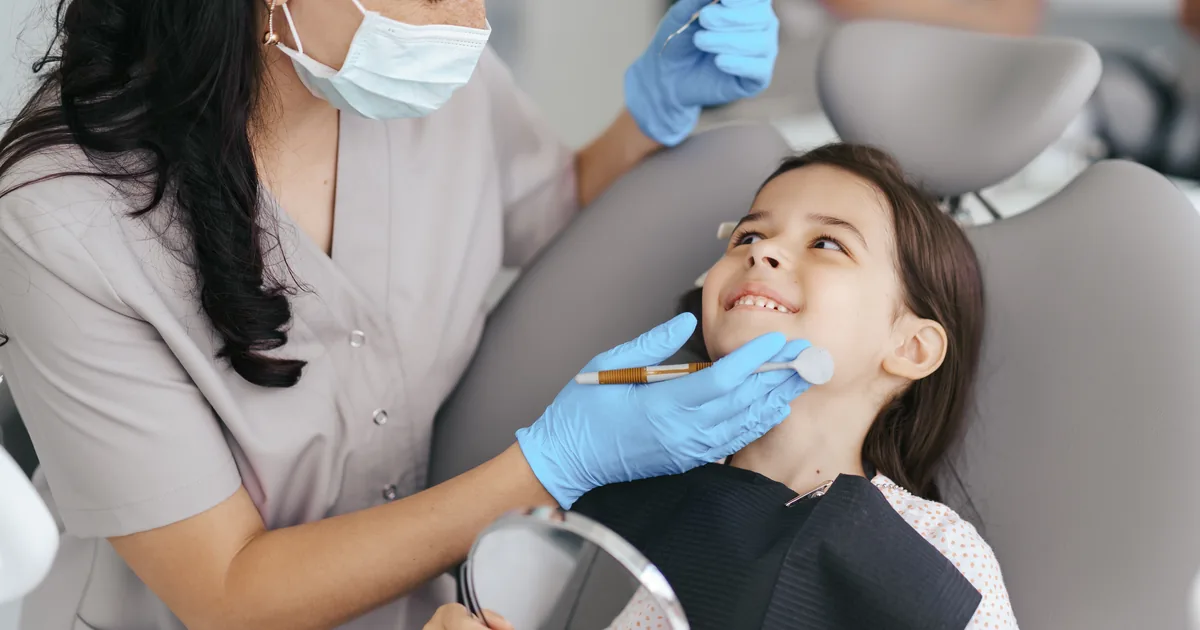
The knee-to-knee examination. For toddlers, you sit facing the dentist with your knees touching, and your child lies back with their head in the dentist’s lap and their body on yours. They can see you the whole time. It takes a minute or two and gives a clear view of every tooth.
A look at teeth, gums and bite. We check for early decay, look at how the teeth are coming through, and check the soft tissues — including the tongue and frenulum, which occasionally affect feeding.
A gentle clean if appropriate. Often just a soft brush and a wipe. Nothing that requires cooperation the child cannot give.
Fluoride varnish. A quick paint-on application that strengthens enamel. It takes seconds and tastes fine.
The conversation. Usually the longest part. Diet, bottle and cup habits, brushing technique, teething, dummy and thumb habits, and what to expect over the next six months.
No drills. No needles. Nothing that requires a child to sit still for long. If your child cries — and plenty do, because they are one and they are somewhere unfamiliar — that is entirely normal and not a problem. We are used to it and it does not stop us doing what we need to do.
The habits that matter most before age three
Never put a child to bed with a bottle of anything but water. Milk, formula and juice all contain sugars. During sleep, saliva flow drops sharply, so those sugars sit against the teeth for hours with none of the natural rinsing that happens while awake. This single habit causes a large share of severe decay in toddlers, and it is completely preventable.
Move from bottle to cup around age one. Prolonged bottle use extends the exposure described above and can affect how the front teeth and jaw develop.
Start brushing as soon as the first tooth appears. A smear of fluoride toothpaste the size of a grain of rice for under-threes; a pea-sized amount from three onwards. Twice a day.
Brush for them, not just with them. Children do not have the manual dexterity to brush effectively until around age seven or eight — roughly when they can tie their own shoelaces reliably. Let them have a go for independence, then you do it properly afterwards. Standing behind them and tilting their head back against you gives far better access than facing them.
Watch the frequency of sugar, not just the amount. A biscuit eaten in one go is less damaging than the same biscuit grazed on across an hour. Each exposure restarts an acid attack lasting roughly twenty minutes. Constant snacking means constant acid.
Do not share spoons or clean a dummy in your own mouth. The bacteria most associated with decay are transmissible, and they are commonly passed from caregiver to child this way.
What comes after the first visit
Most children settle into a check-up every six months, which is also when we would do routine cleanings and exams. For children at higher risk of decay, we sometimes recommend more frequent fluoride applications.
A few milestones worth knowing:
- Around age six, the first permanent molars arrive at the very back — behind the baby teeth, with nothing falling out first. Many parents do not realise these have come through, and assume they are still baby teeth that will be replaced. They will not be. These are permanent teeth that need to last a lifetime, and because they arrive so early they are among the most commonly decayed teeth in the mouth.
- Sealants can be applied to the biting surfaces of those molars. The grooves are deep and difficult to clean, and a sealant fills them so plaque cannot settle. It is quick, painless, and one of the most effective preventive measures available for children.
- Around age seven, it is worth assessing how the bite and jaw are developing. Some orthodontic problems are far easier to guide early, while the jaw is still growing, than to correct later.
If a baby tooth gets decayed, does it matter?
Yes — this comes up often, and the assumption that baby teeth do not count because they fall out anyway is one worth correcting.
Baby teeth hold space for the permanent teeth developing underneath. Lose one early and the neighbouring teeth drift into the gap, so the adult tooth arrives to find there is no room for it. That is a common route into orthodontic treatment that could have been avoided.
They also matter right now. Decayed teeth hurt, and a child in pain does not sleep well, eat properly, or concentrate at school. Infection in a baby tooth can also damage the developing permanent tooth underneath it.
Treating decay in a baby tooth with a small filling is quick and straightforward. Waiting until it abscesses is neither.
If your child has never been and they are already five
You have not ruined anything. Bring them in.
The main thing is to make the first visit a low-stakes one — a check-up rather than a response to a problem — so that the association starts on the right footing. Book it when there is nothing wrong.
A few things that help:
- Avoid reassurance words. “It won’t hurt” plants the idea that hurting was on the table. Say they are going to count your teeth and take a look.
- Do not share your own dental anxiety. Children read parents closely. If you dread the dentist, try to keep that to yourself in front of them.
- Book a morning appointment when they are rested rather than at the end of a long day.
- Read a book about visiting the dentist beforehand. There are plenty and they genuinely help.
If your child is in pain now, that changes the order of things — call us and we will get them seen quickly rather than waiting for a routine slot.
Frequently asked questions
My child has no teeth yet. Is there any point coming in?
Once the first tooth appears, yes. Before that, the useful things are cleaning the gums with a damp cloth and avoiding sleeping with a bottle. If you have questions before the first tooth arrives, call and ask — you do not need an appointment for that.
What if my child will not open their mouth?
Very common, and not a failure. We work with what we get. Sometimes the first visit is mostly about the child sitting in the chair and seeing that nothing bad happens, and the actual examination happens more easily at the second visit. There is no rush.
Does my child need X-rays?
Not usually at the first visits. X-rays are taken when there is a specific reason — for example, when back teeth are touching and decay between them cannot be seen directly, or if there is a concern about a tooth that has not appeared. We take them when they will change what we do, not routinely.
Is fluoride varnish safe for a one-year-old?
Yes. The amount applied is very small, it sets on contact with saliva, and it is widely recommended for young children by pediatric dental bodies. It is one of the most effective things we can do to reduce decay risk at this age.
Book your child’s first visit in Merced
If your child has a tooth and has not yet seen a dentist, now is the right time — whatever their age. The first appointment is short, gentle, and largely a conversation with you.
Dr. Swetha Nadipally sees patients of every age, from first teeth through to adult and senior care, so your whole family can be seen in one place.
Shine Dental Group
155 W El Portal Dr, Suite C, Bld 12
Merced, CA 95340
Phone: (209) 749-1444
Email: shinedentaldds@gmail.com
Book your child’s first visit — we welcome new patients and will check your insurance coverage beforehand.